Large language model (LLM) agents are increasingly expected to assist users in completing tasks. However, existing benchmarks provide limited support for evaluating whether agents can carry out office-suite workflows at a reasonable cost. We introduce OmegaUse-OfficeVal, a benchmark for evaluating LLM agents on long-horizon office-suite tasks with task-level economic grounding. The benchmark comprises 100 tasks derived from office-suite requests proposed by practitioners and adapted through a privacy-preserving process. On average, these tasks require 2.32 hours of human labor to complete. An important feature of the benchmark is that each task is paired with two economic signals: human labor time and task price proxy. These signals enable direct comparisons between human costs and LLM inference costs, as well as value-weighted evaluation. To support stable evaluation, we develop code-based verifiers from fine-grained rubrics. We evaluate several frontier LLMs together with a human baseline. Although all evaluated LLMs are substantially cheaper and faster than human workers, they have not yet approached human-level deliverable quality. The code and dataset are fully open-sourced, and more information is available on our project website: https://omegause-officeval.github.io/.
OmegaUse-OfficeVal: Benchmarking LLM Agents on Long-Horizon Office-Suite Tasks with Economic Grounding
Agent Frontier Team, Large Model Frontier Research Department, Baidu Inc.
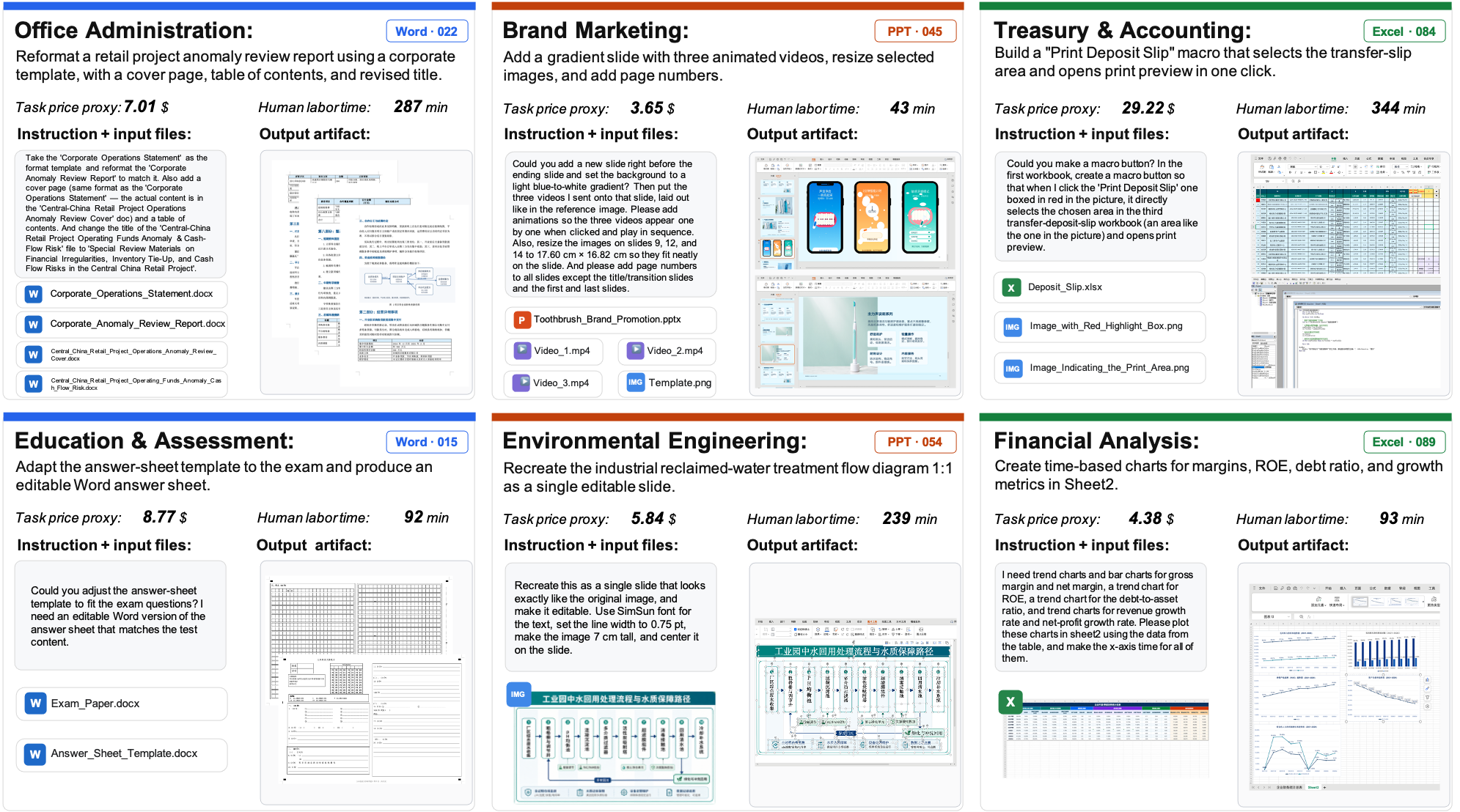
Task examples
Task Examples of OmegaUse-OfficeVal
Abstract
A benchmark for evaluating LLM agents on economically grounded, long-horizon office-suite tasks.
Task overview
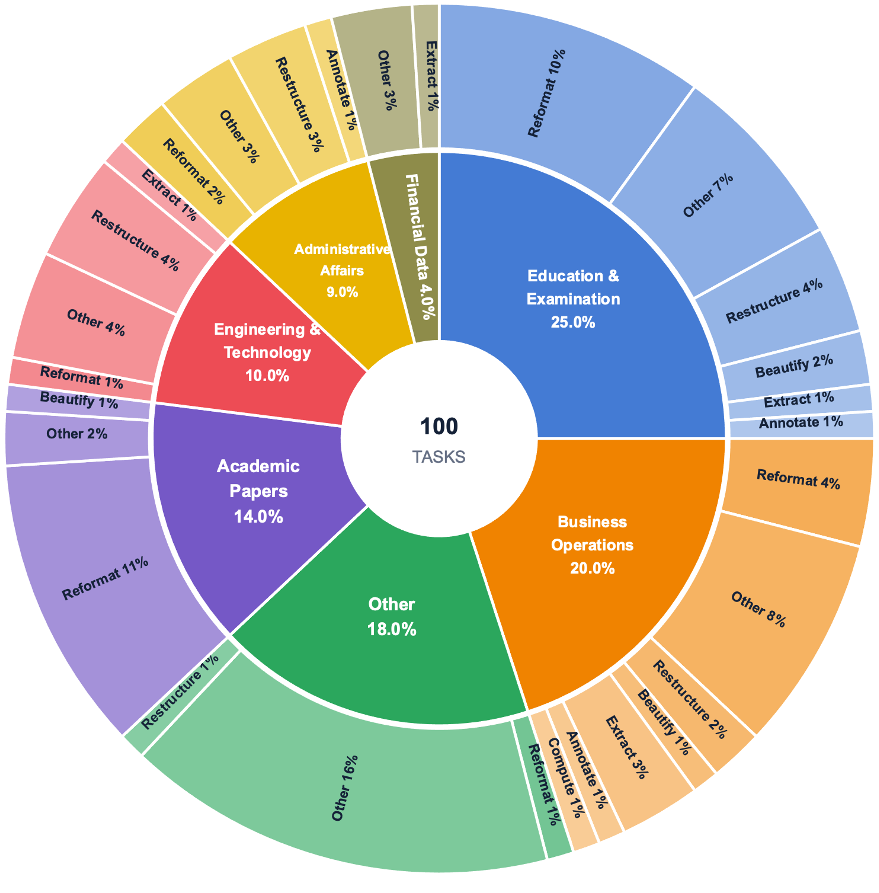
100 authentic tasks reflecting long-horizon Office-Suite work.
Files and economic signals
Multimodal inputs, editable deliverables, and task-level economically grounded annotation.
| File type | Input files | Output artifacts |
|---|---|---|
| Video / Audio | 10 | 0 |
| Image | 77 | 0 |
| DOCX | 63 | 48 |
| PPTX | 31 | 40 |
| XLSX | 25 | 24 |
| 14 | 3 | |
| Total | 220 | 115 |
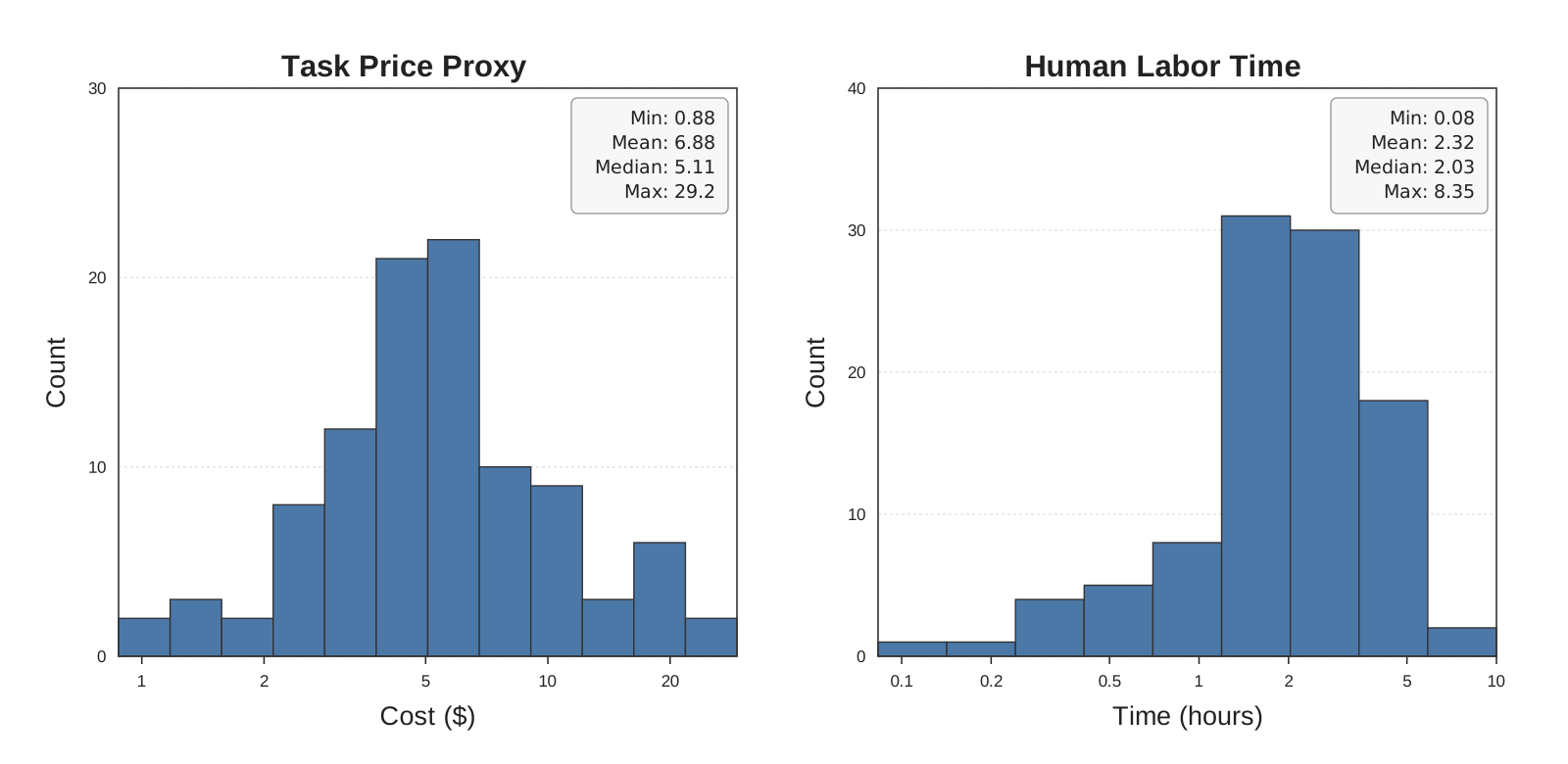
2.03 hours median, with the longest task requiring 8.35 hours.
$5.11 median, combining practitioner prices and three-expert estimates.
Trajectory-agnostic scoring supports GUI, scripts, APIs, and hybrid workflows.
Task distribution
Construction pipeline
From 1,715 practitioner proposals to 100 verified long-horizon Office-suite tasks.
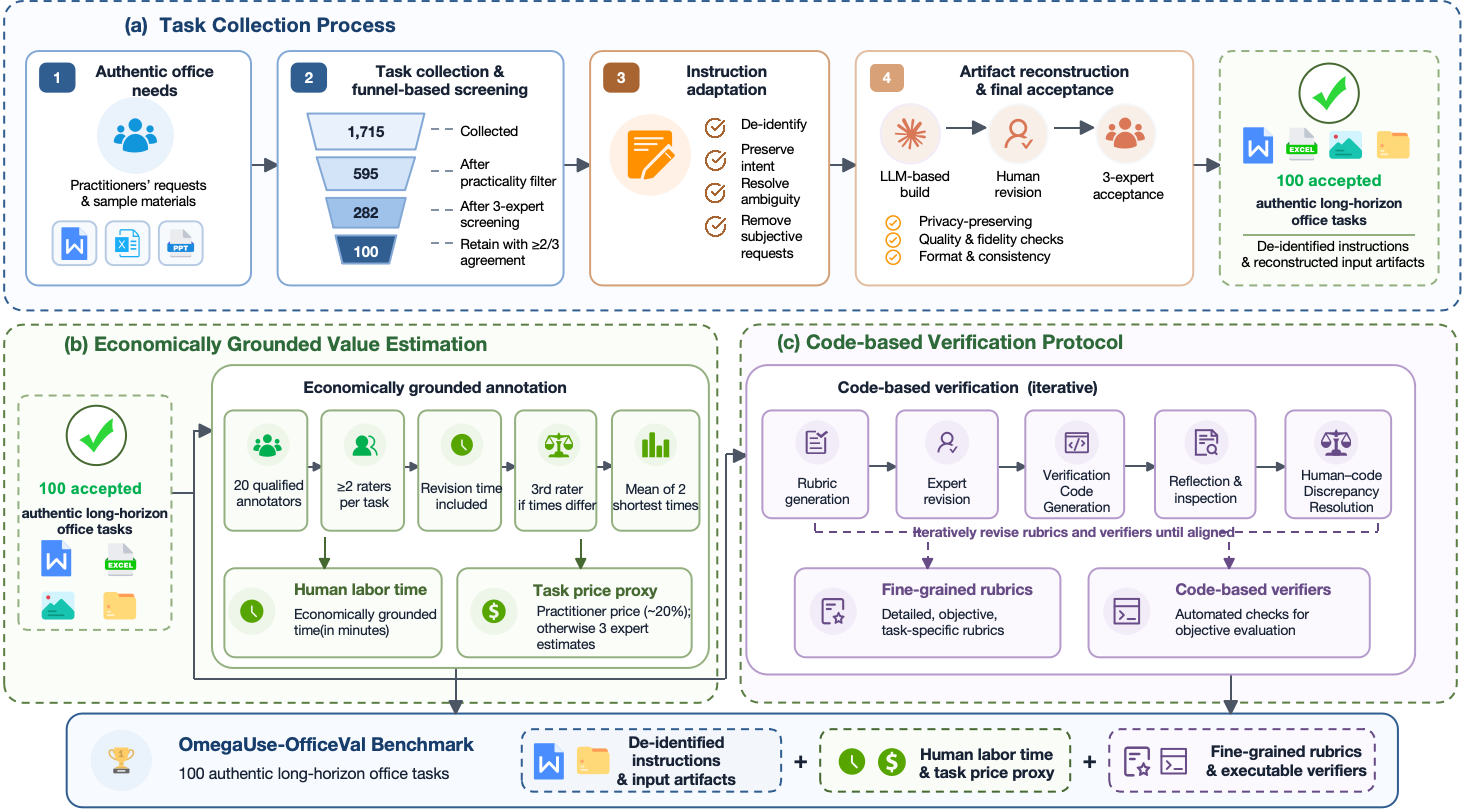
Practicality filtering and three-expert screening retain only authentic, feasible long-horizon work.
At least two people complete each task; the mean of the two shortest valid times defines human labor time.
Task rubrics are translated into executable checks and revised until human and code judgments align.
Leaderboard
Quality, time, and cost reveal different model strengths.
Highest overall score, but still far from perfect on these demanding workflows.
The strongest average deliverable score among the evaluated LLMs.
Highest time- and price-weighted LLM scores, at $0.2152 per task.
0.184 hours per task on average.
| Rank |
|---|
Time- and price-weighted scores weight each task by its annotated human labor time or task price proxy. Human cost is the mean task price proxy; LLM cost is inference expenditure. Time is reported in hours per task.
Analysis
LLMs are much cheaper and faster, but the deliverable-quality gap remains.
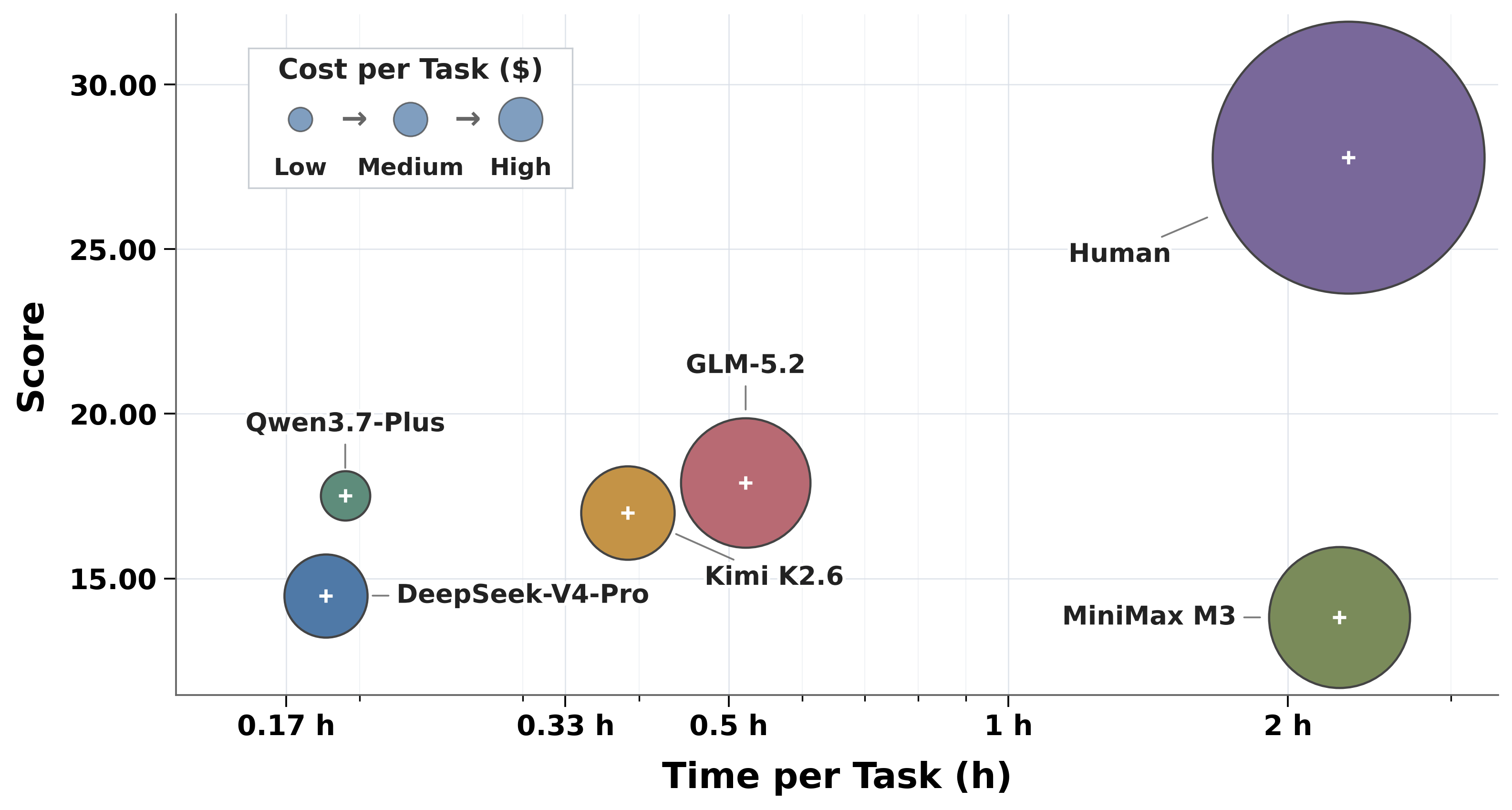
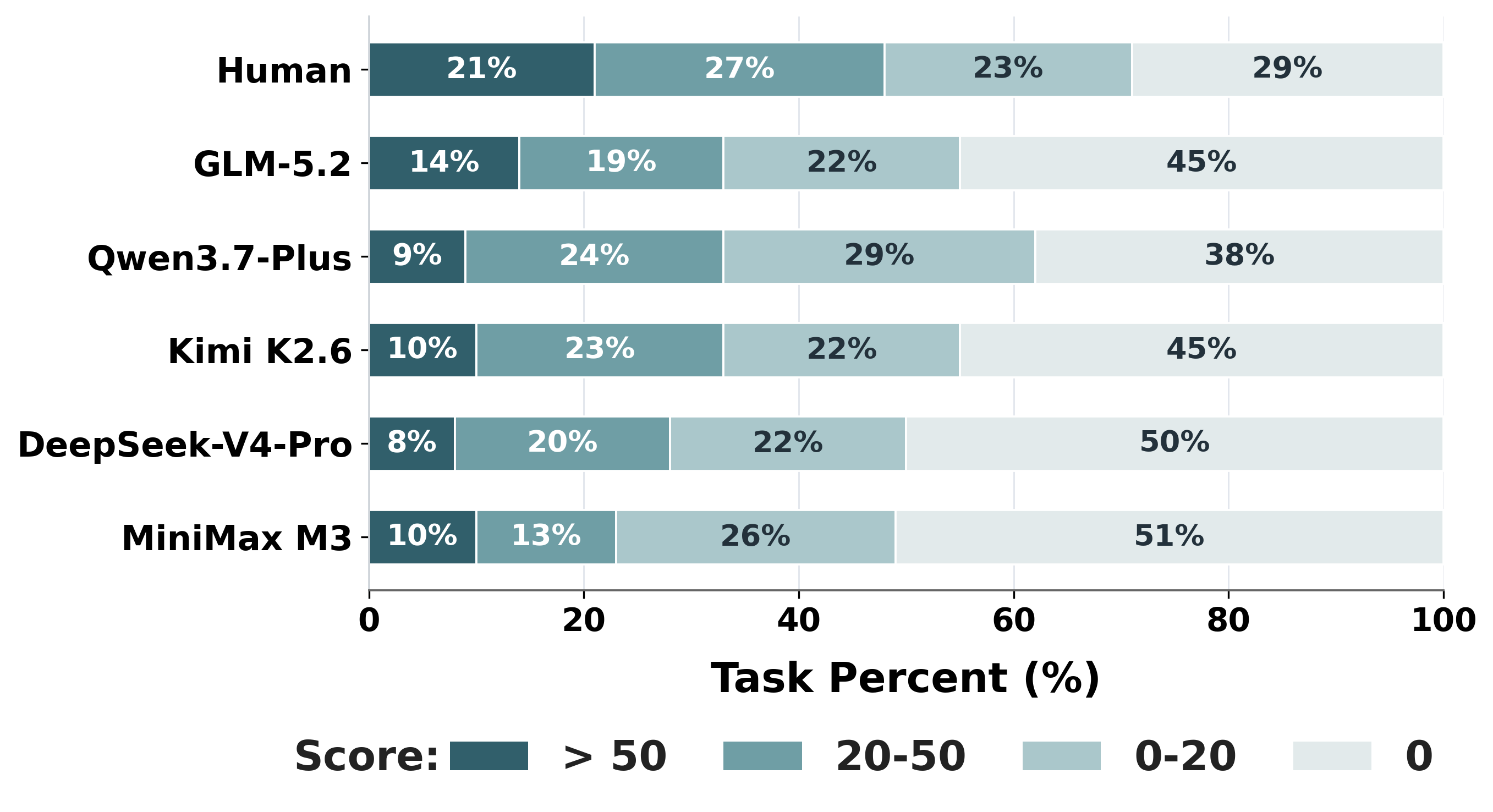
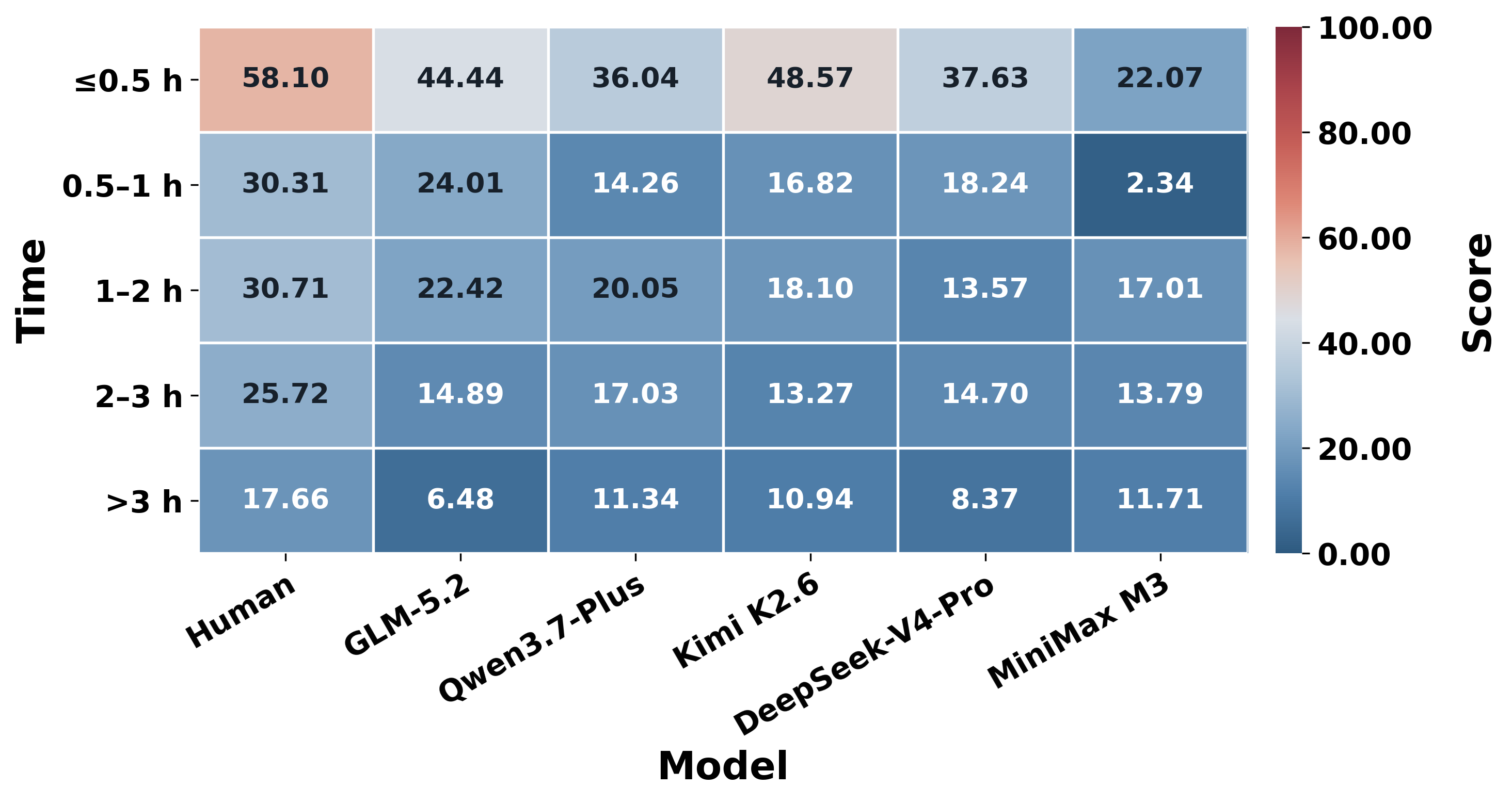
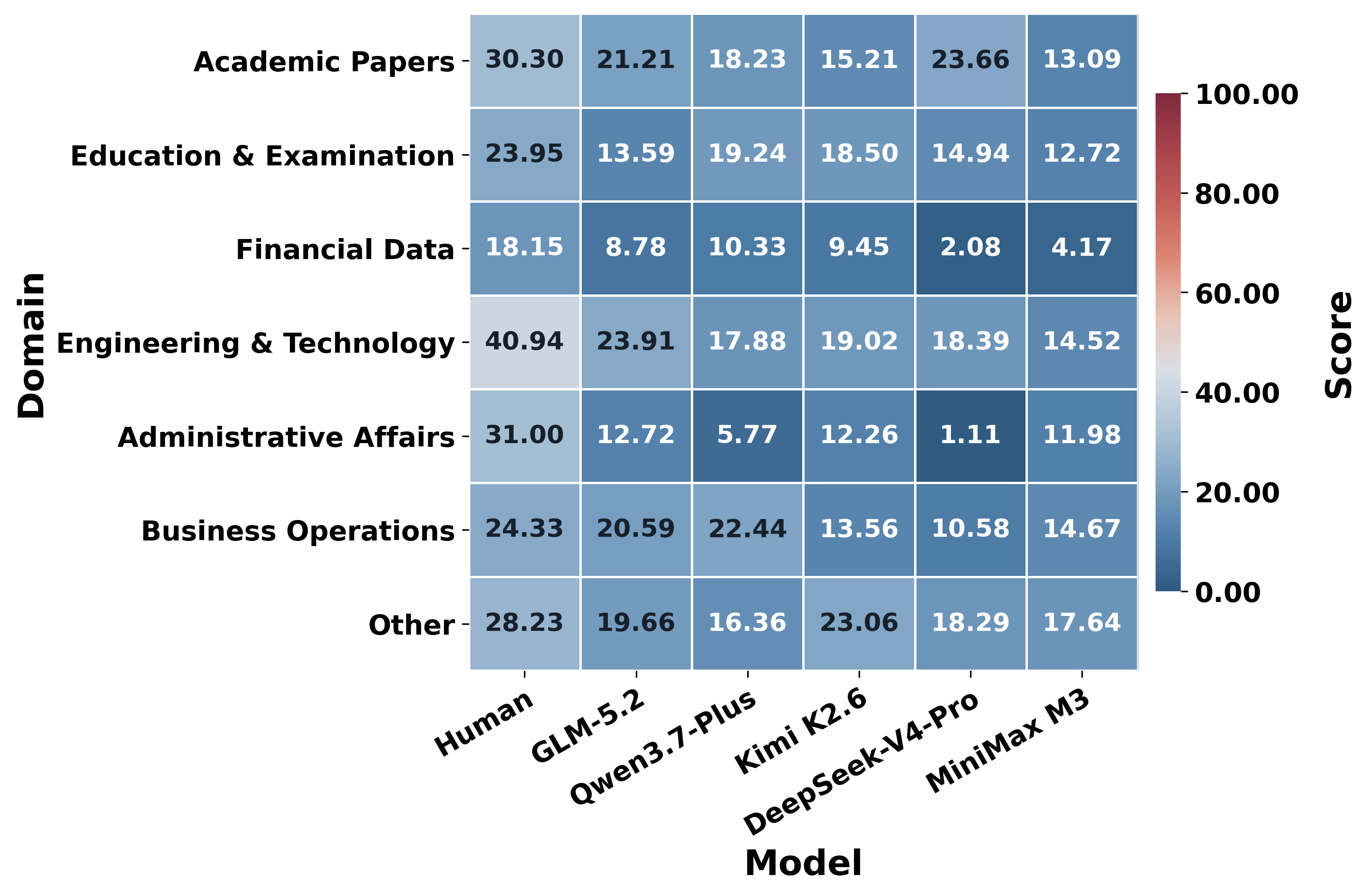
Explore domain, output-file, and operation-intent breakdowns
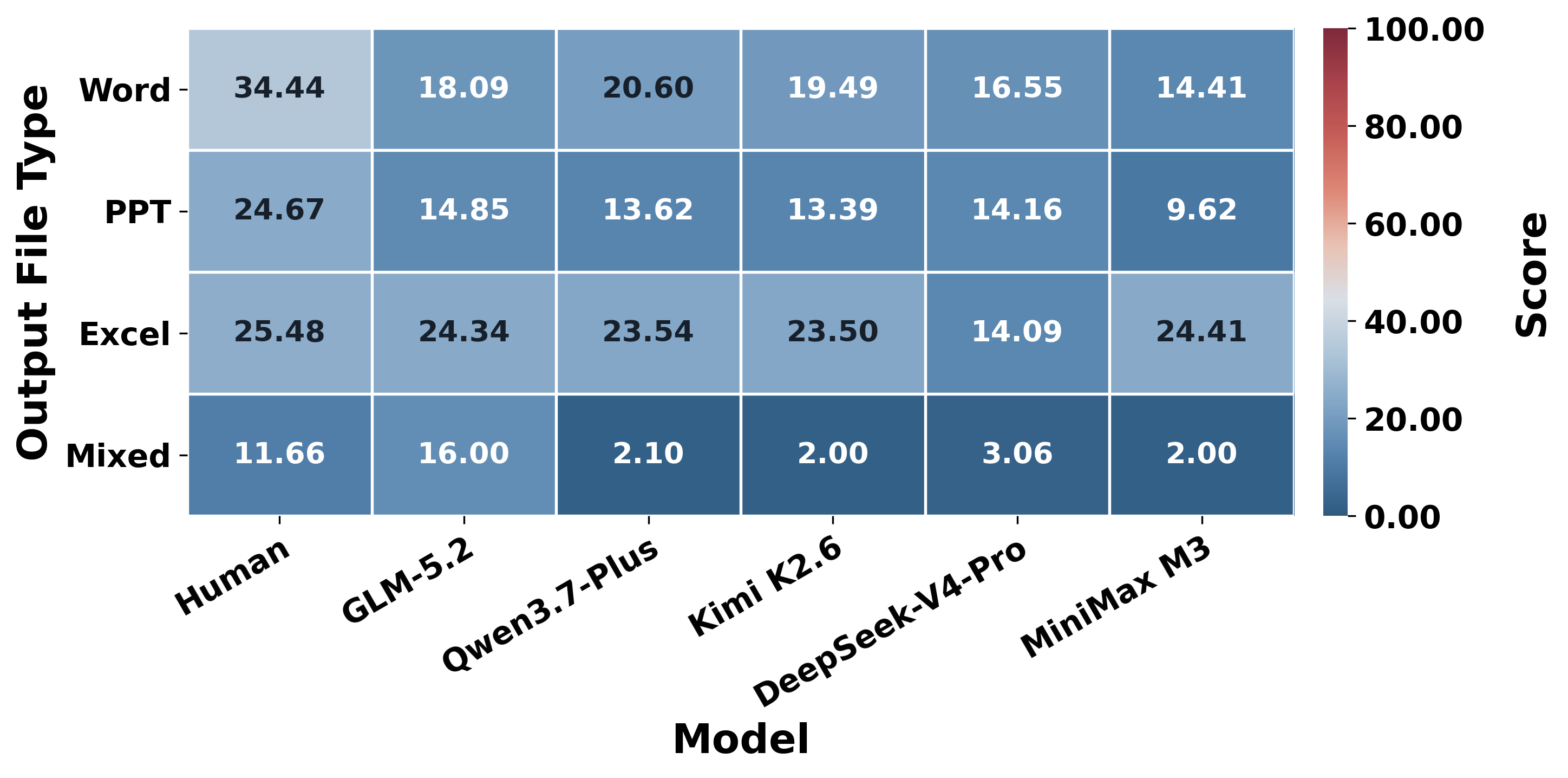
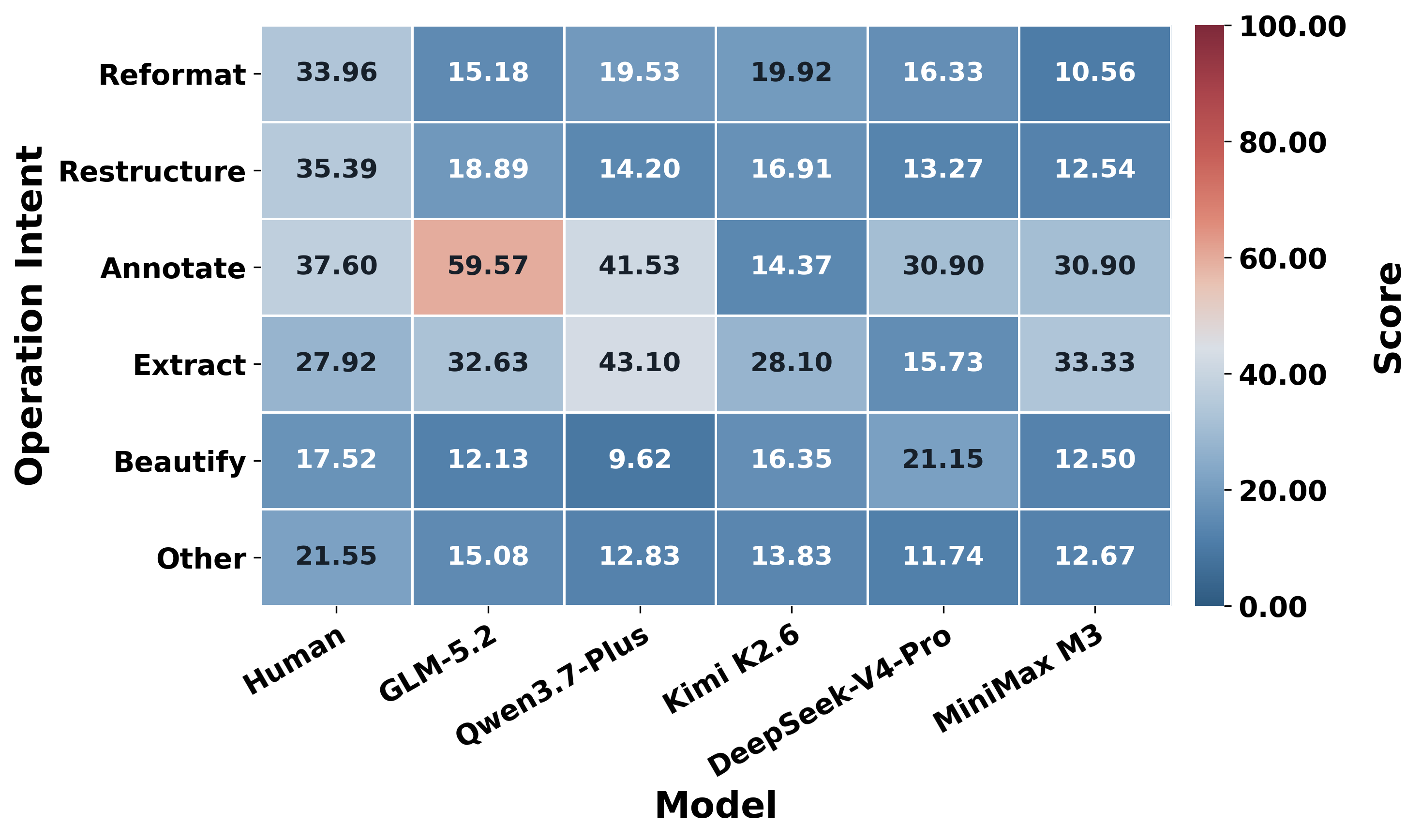
Coding Actions vs. Computer-Use Actions on Office-Suite Tasks
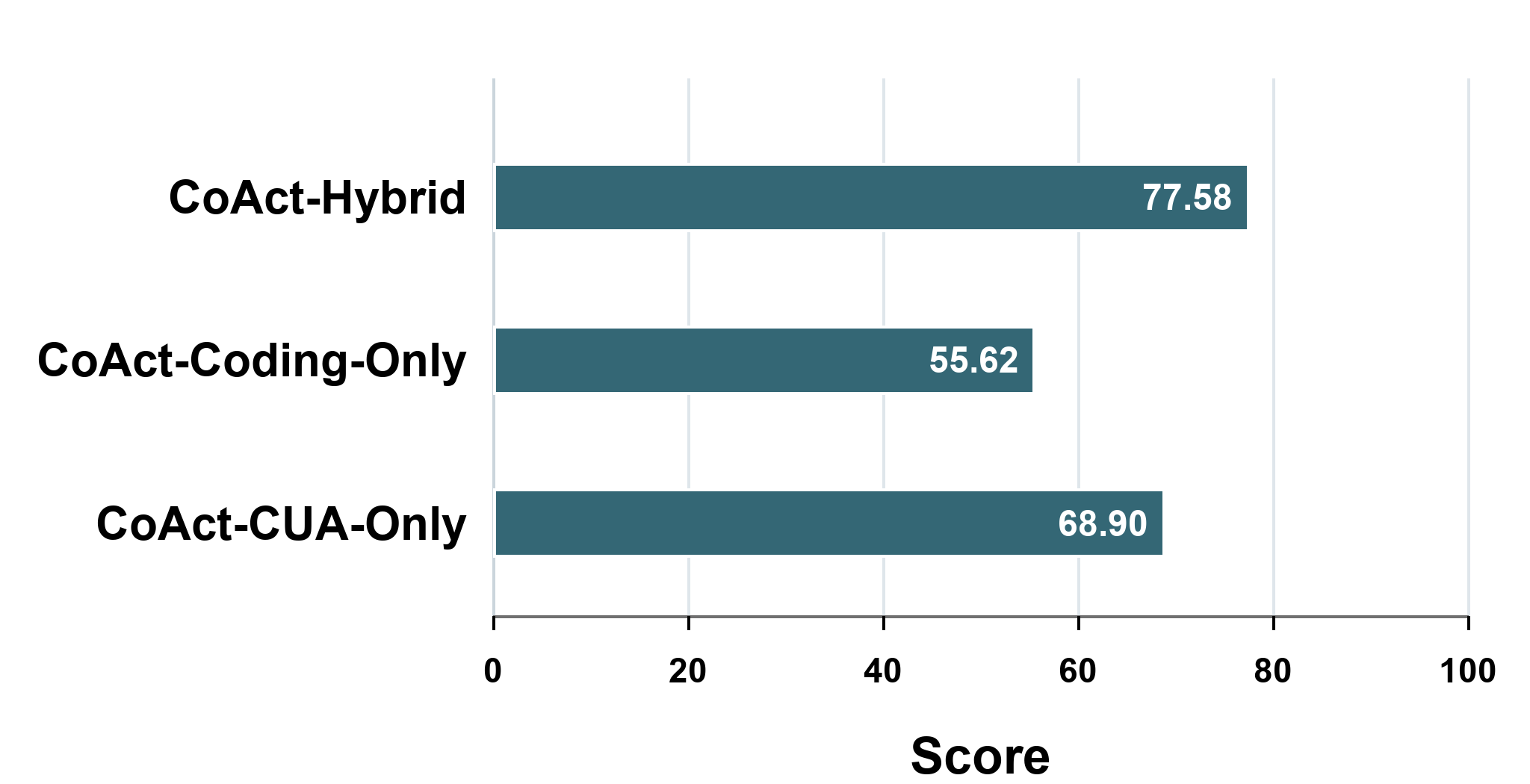
Should an office agent work through visual interfaces, manipulate files with code, or combine both? Using K2.6, we compare three CoAct variants across OmegaUse-OfficeVal and OSWorld office-related tasks.
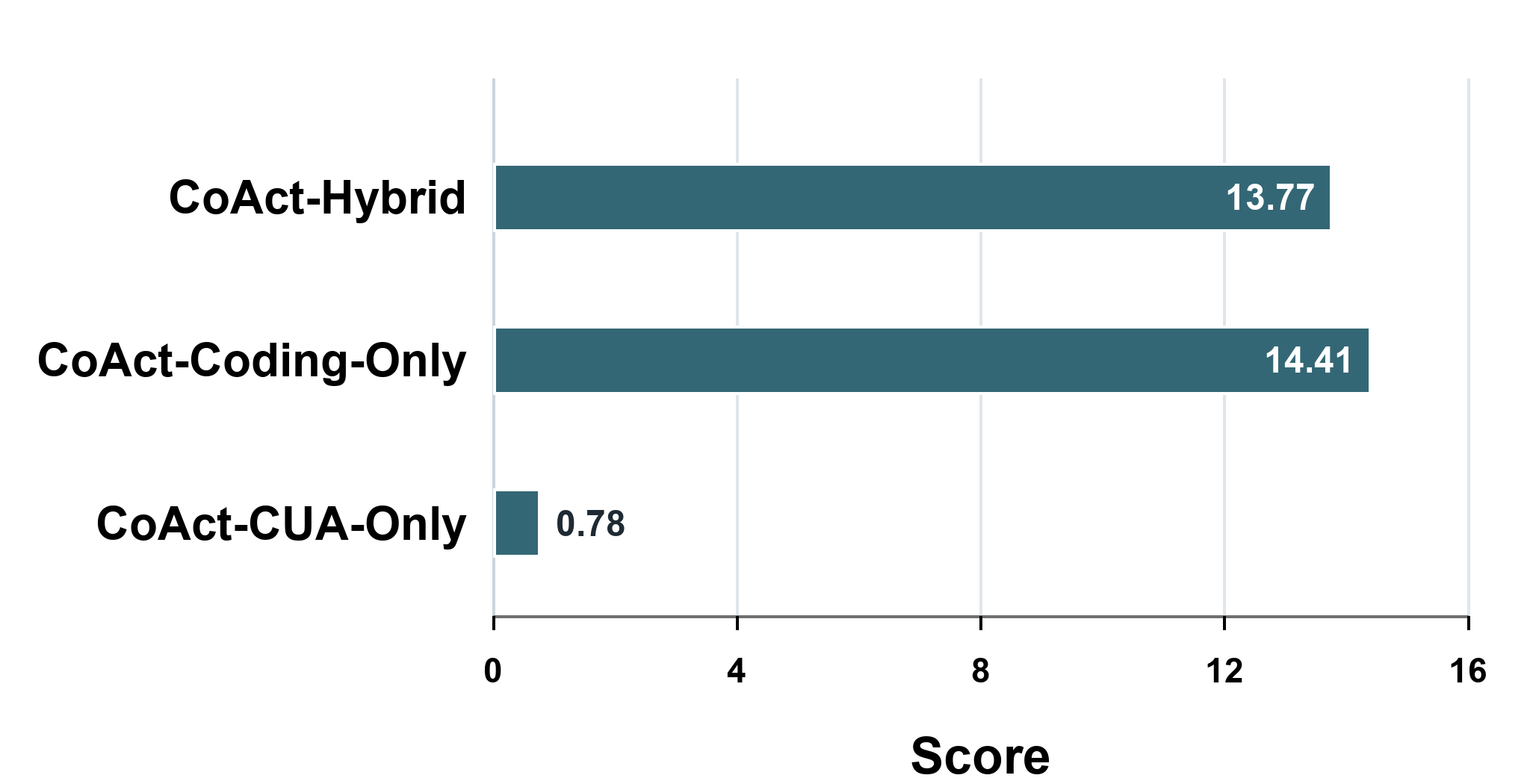
Long-horizon deliverables favor coding. On OmegaUse-OfficeVal, Coding-Only leads at 14.41, Hybrid follows at 13.77, and CUA-Only falls to 0.78.
Visual interaction still matters. On OSWorld office tasks, Hybrid leads at 77.58, ahead of CUA-Only at 68.90 and Coding-Only at 55.62.
Takeaway: there is no single best action mode for every office task. Coding provides reliable file-level execution for long workflows, while computer use remains valuable for visual grounding and application-level interaction. Learning when to route between the two remains an important open problem.
Resources
Paper, dataset, and verification code are openly available.
Reproduce
Evaluate a complete set of office-suite deliverables locally.
Prepare
Package task directories named officeval_001 through officeval_100 in a ZIP archive.
Evaluate
The CLI validates the archive and runs each verifier in an isolated subprocess.
Inspect
Review machine-readable JSON and CSV summaries together with per-task verifier reports.
Quick start
python -m pip install -e .
omegause-officeval --package /absolute/path/to/submission.zip
Platform note
Ninety-one verifiers run in normal cross-platform mode. Nine designated verifiers require Microsoft Office COM on Windows; in automatic mode they are skipped on macOS and Linux.
FAQ
Common equations and evaluation details.
Why attach economic signals to every task?
Human labor time and task price proxy enable human-versus-LLM cost comparisons and value-weighted evaluation.
Does the benchmark require a particular agent interface?
No. Evaluation targets final deliverables, so agents may use GUI actions, scripts, APIs, or hybrid workflows.
How is scoring stabilized?
Fine-grained rubrics are converted into executable checks and revised through expert review and human-code discrepancy resolution.
Citation
Cite OmegaUse-OfficeVal.
@misc{zhou2026omegauseofficeval,
  title        = {OmegaUse-OfficeVal: Benchmarking LLM Agents on Long-Horizon Office-Suite Tasks with Economic Grounding},
  author       = {Jingbo Zhou and Yusai Zhao and Qi Bao and Jingjia Cao and Zhenghai Chen and Chang Gao and Kaiqi Guo and Muxin Guo and Mingxuan Li and Xinjiang Lu and Yanru Ma and Yixiong Xiao and Zenghui Zhang and Le Zhang and Hua Wu},
  year         = {2026},
  eprint       = {2607.27155},
  archivePrefix = {arXiv},
  primaryClass = {cs.AI},
  url          = {https://arxiv.org/abs/2607.27155}
}Team
Agent Frontier Team, Large Model Frontier Research Department, Baidu Inc., China.
* Equal contribution. † Project co-lead and corresponding authors.